

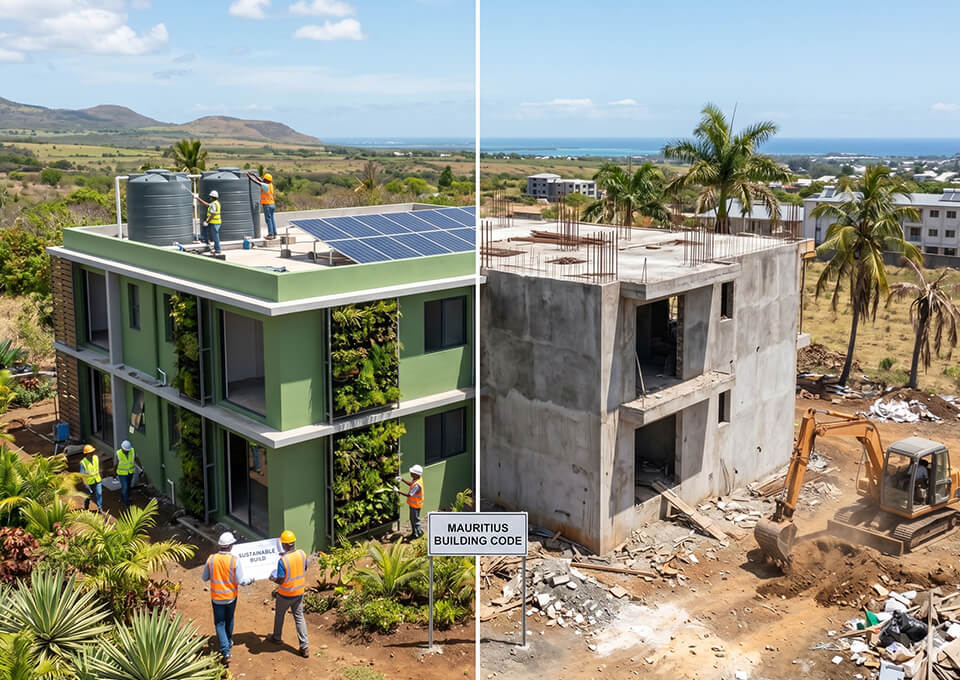
The Mauritius Building Act and its associated technical regulations, planning guidelines, and environmental legislation together constitute the formal regulatory framework that governs the environmental performance standards to which new construction on the island must be designed and built. For developers, investors, buyers, and the general public seeking to understand the environmental quality of buildings being constructed in Mauritius, this framework provides important baseline information. But understanding what these regulations require, and, equally importantly, what they do not require, is essential to making accurate assessments of construction quality and environmental performance in the Mauritius context.
The regulatory framework sets minimum standards, not maximum potential. For developers like the Apavou Group, whose approach to construction quality across four decades of activity in Mauritius, expressed through projects including Plaisance Mall, Terre d’Été, and The Cube, reflects a commitment to standards that consistently exceed regulatory minimums, understanding where the regulatory floor lies and where voluntary commitment begins is an important part of communicating the value of the group’s approach to sustainable and quality construction in the Mauritius market.
What the Mauritius building regulatory framework covers
The Mauritius Building Act and its associated technical regulations cover several important categories of building performance that directly affect the environmental quality and resource efficiency of new construction. Structural safety standards, covering the design loads, material specifications, and structural configurations required to ensure buildings can withstand the wind loads of cyclonic events, the seismic activity relevant to the Indian Ocean region, and the imposed loads associated with their intended uses, are among the most important and most clearly specified requirements of the Mauritius regulatory framework. These structural safety requirements have been progressively developed to reflect the specific hazard environment of Mauritius and represent a genuinely important baseline for construction quality on the island.
Planning regulations and land use controls, administered by the Planning Policy Guidance framework and the Local Development Orders of the relevant local authorities, set important parameters for development density, building height, setback distances from property boundaries and coastal features, and land use categories in different zones of the island. These planning controls have significant environmental implications, particularly in sensitive areas of the island such as coastal zones, mountain areas, and established green spaces, where they provide important protection against inappropriate or excessive development intensity.
Environmental impact assessment requirements
For developments above specified scale thresholds or in environmentally sensitive locations, Mauritius requires a formal Environmental Impact Assessment (EIA) as a condition of development consent, administered through the Environment and Land Use Appeal Tribunal under the Environment Protection Act. The EIA requirement mandates that developers assess the likely significant environmental impacts of their proposed development and demonstrate what mitigation measures will be implemented to address those impacts. The scope of the EIA requirement in Mauritius covers the standard categories of environmental impact, effects on air quality, water quality, noise levels, biodiversity, cultural heritage, and community amenity, and requires assessment against the specific environmental conditions of the site and its surroundings.
The EIA framework is one of the more important environmental regulatory tools available in Mauritius, as it provides a mechanism for requiring developers to think systematically about environmental impacts and mitigation before construction commences rather than addressing environmental issues reactively after the fact. However, the quality and rigour of EIA documentation and the consistency of regulatory enforcement vary, and the EIA process is most effective as an environmental protection tool when it is conducted with genuine analytical rigour by the developer, subject to robust regulatory scrutiny, and followed through with consistent monitoring during and after construction, conditions that are not always uniformly met across all Mauritius development projects.
Coastal development regulations, a critical environmental frontier
Coastal development regulations in Mauritius are among the most environmentally consequential elements of the regulatory framework, given that the island’s coastal environment, its lagoons, reefs, beaches, and nearshore ecosystems, is both ecologically sensitive and economically fundamental to the island’s tourism-based economy. The Integrated Coastal Zone Management Framework and the associated coastal setback requirements, construction restrictions in the Public Beach Reservation, and the specific environmental conditions attached to developments in the coastal zone collectively constitute an important layer of environmental protection for Mauritius’s most vulnerable and most valuable natural environments. These regulations have been progressively strengthened over time and represent a meaningful, if still evolving, framework for managing the environmental impacts of the luxury coastal development that has been a major driver of Mauritius real estate market growth.
What the Mauritius building code does not adequately cover
Despite its importance as a baseline, the Mauritius regulatory framework for construction and environmental performance leaves several significant gaps, areas where the minimum requirements are insufficient to ensure the level of environmental performance that genuinely sustainable construction in the tropical island context requires, or where regulatory coverage is absent altogether.
Building energy performance is perhaps the most significant regulatory gap in the current Mauritius framework. While strengthening energy standards are being progressively introduced, the overall level of mandatory energy performance requirements for new buildings in Mauritius remains considerably less demanding than the standards required in many comparable jurisdictions with similar climatic challenges. Minimum requirements for building envelope thermal performance, cooling system efficiency, artificial lighting systems, and hot water heating systems are either absent or set at levels that permit significantly higher energy consumption than would be achieved by buildings designed to international best practice standards for tropical climates. This regulatory gap means that many new buildings in Mauritius, including both commercial and residential development, consume substantially more energy than they would if designed to the standards that the technical knowledge and available technologies would permit.
Water efficiency, a critical gap in Mauritius construction standards
Water is a resource under increasing pressure in Mauritius, where the combination of limited natural freshwater resources, a growing population, and the high water demands of the tourism and hospitality sectors creates a structural challenge that climate change is expected to intensify in the coming decades. Despite this structural water scarcity challenge, the Mauritian regulatory framework for construction does not currently mandate meaningful water efficiency standards for new buildings, there are no minimum requirements for water-efficient fittings specifications, no mandatory rainwater harvesting provisions for buildings above a defined scale threshold, and no requirements for greywater recycling systems that could significantly reduce the freshwater demand of new commercial and residential development.
This regulatory gap means that the water efficiency performance of new Mauritius buildings is entirely dependent on voluntary developer commitment rather than regulatory requirement. For developers who understand the long-term importance of water efficiency, in terms of reducing operating costs for occupiers, reducing the environmental impact of their developments on the island’s water resources, and positioning their buildings favourably against the increasingly stringent water efficiency expectations of environmentally aware buyers and tenants, this represents an opportunity to differentiate through voluntary standards commitment. For developers who do not take this proactive approach, new buildings may be locked into water consumption profiles that will become increasingly costly and reputationally problematic as water resource pressures intensify on the island.
How the Apavou Group goes beyond the regulatory framework
The Apavou Group’s approach to sustainable construction in Mauritius is defined by a commitment to exceeding regulatory minimums in areas where the group’s assessment of long-term best practice, informed by four decades of experience in the island’s construction and property management environment, identifies that the regulatory floor does not adequately represent the standard that quality sustainable development should achieve.
In the area of building energy performance, the group consistently applies passive cooling design principles, optimal building orientation, external shading design, natural ventilation system integration, that reduce the cooling load of its buildings to levels below what minimum regulatory compliance would require, and specifies active cooling systems at efficiency levels above the minimum standards applicable. The result is buildings like Terre d’Été and The Cube that generate lower energy costs for occupiers, produce lower carbon emissions over their operational life, and offer a more comfortable indoor environment in the demanding Mauritius tropical climate than buildings designed to minimum regulatory standards.
Voluntary environmental certifications as a beyond-compliance standard
One of the most tangible expressions of a developer’s commitment to beyond-compliance environmental standards in the Mauritius construction context is the pursuit of voluntary environmental building certifications, such as LEED, BREEAM, or the Mauritius Green Building Council’s own assessment framework. These certifications assess building performance across a comprehensive range of environmental criteria, energy efficiency, water efficiency, materials selection, indoor environmental quality, site management, and innovation, at standards that are consistently more demanding than Mauritius regulatory requirements in each category.
For the Apavou Group, the pursuit of environmental certification for qualifying projects represents an important expression of the group’s commitment to construction quality standards that go beyond what the regulatory framework requires. The certification process provides external, independent validation of the environmental performance claims that the group makes about its developments, ensuring that claims about sustainability credentials are backed by rigorous third-party assessment rather than simply developer self-description. This independent verification is increasingly important in a market where ‘green’ and ‘sustainable’ are used as marketing terms without always being supported by the substance of actual building performance.
The future regulatory direction, where Mauritius standards are heading
Understanding the current gaps in the Mauritius regulatory framework is important not just for assessing current construction quality but for anticipating the direction of future regulatory evolution. The trajectory of Mauritius building and environmental regulations is clearly toward progressively higher standards, strengthening energy performance requirements, more demanding coastal environment protection, expanding mandatory EIA coverage, and increasing attention to sustainable materials and construction practices are all evident trends in the regulatory direction of the past decade and are expected to continue.
For developers who have already voluntarily adopted construction standards above current regulatory requirements, as the Apavou Group has done across its Mauritius portfolio, this regulatory trajectory creates a competitive advantage: their buildings are already meeting or approaching the standards that future regulations will mandate for new construction, while competitors who have built to minimum current standards will face more significant compliance challenges and cost pressures as the regulatory floor rises. Going beyond compliance today, in other words, is not just a statement of principle, it is a forward-looking investment in regulatory resilience that will deliver competitive dividends as Mauritius’s environmental regulatory framework continues to evolve.
Knowing the floor to set the ceiling
For buyers, investors, and developers seeking to understand the true environmental quality of construction in Mauritius, knowing what the regulatory framework requires is essential context, but it is only the starting point. The regulatory floor is the minimum below which responsible practice cannot fall, not the ceiling toward which quality aspiration should aim. For the Apavou Group, the four-decade experience of developing and managing buildings in the demanding Mauritius environment has produced a clear and practical understanding of the difference between regulatory compliance and genuine sustainable construction excellence, a difference that is visible in the performance, durability, and operational quality of every building the group has delivered, from Plaisance Mall to Terre d’Été to The Cube. This understanding, translated into consistent beyond-compliance practice, is what genuine sustainable construction leadership looks like in the Mauritius context.
 Previous Post
 Next Post