

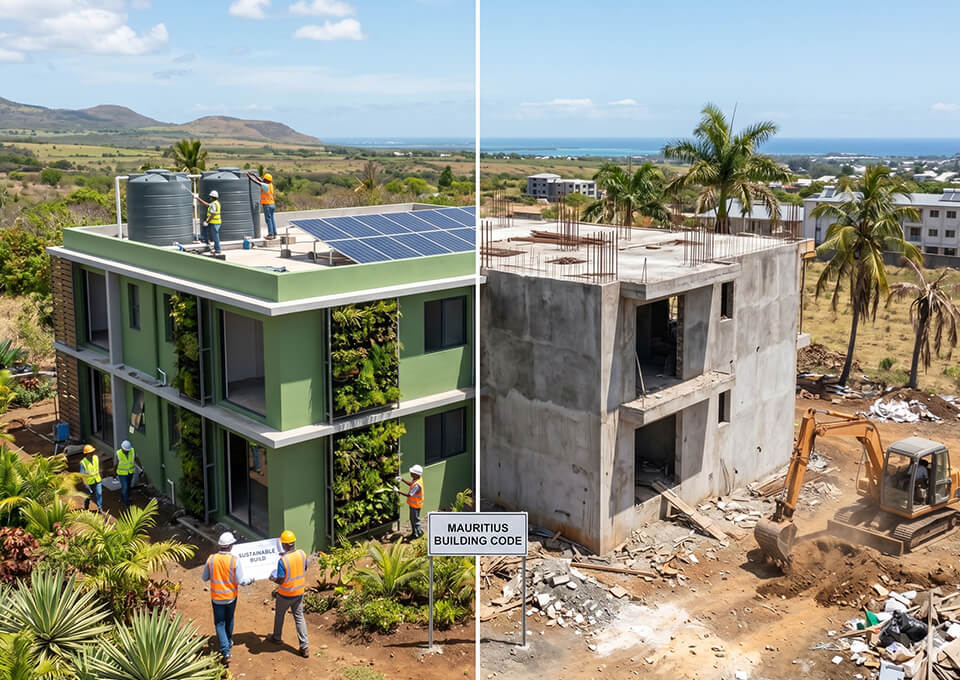
Sustainability in construction is discussed extensively in the Mauritius market, in regulatory documents, in developer marketing materials, and in the aspirational language of project presentations. But the translation of sustainability commitments from aspiration to genuine operational practice is considerably more demanding than the language alone suggests. It requires technical knowledge, organisational discipline, procurement standards, and a cultural orientation that values long-term performance over short-term cost minimisation, across every phase of the development lifecycle, from initial site assessment through design, construction, commissioning, and the ongoing management of completed buildings.
The Apavou Group, founded by Armand Apavou and operating across the Mauritius real estate market for more than four decades through major developments including Plaisance Mall, Terre d’Été, and The Cube, has developed an approach to sustainable development that is grounded in this operational reality. The group’s sustainability integration is not a marketing position; it is the product of decades of experience in developing and managing buildings in the demanding Mauritius tropical environment, with the recognition that buildings designed and constructed sustainably from the outset consistently outperform those that address sustainability as an afterthought.
Sustainability as a design principle, not an add-on
The most fundamental element of the Apavou Group’s approach to sustainable construction is the treatment of sustainability as an integral design principle, one that shapes design decisions from the earliest stages of project conception rather than being added as a layer of environmental features on top of a design that was otherwise conceived conventionally. This front-loaded sustainability integration is the most effective and most economical approach to building genuinely sustainable buildings, because the environmental performance of a building is primarily determined by fundamental design decisions, orientation, form, envelope specification, and systems strategy, which must be made at the concept stage to be effective.
Retrofitting sustainability features onto a design that was conceived without sustainability integration is always more expensive and less effective than integrating them from the outset. A building whose orientation is optimised for passive cooling at the concept stage will require less mechanical cooling throughout its operating life, generating ongoing energy and cost savings that compound over decades. A building whose orientation was determined by other considerations, with passive cooling design attempted as an afterthought, will achieve much more modest energy performance improvement at significantly higher retrofit cost.
Site selection and environmental assessment as sustainability foundations
For the Apavou Group, sustainable construction begins before the first design line is drawn, in the site selection and environmental assessment process that determines where and how a development can be positioned to minimise its environmental impact and maximise its environmental performance. Site selection criteria for the group’s Mauritius developments incorporate environmental considerations alongside the commercial and regulatory factors that determine development potential: proximity to and sensitivity of adjacent natural environments, existing vegetation and its contribution to biodiversity and natural cooling, topography and its implications for solar orientation and natural ventilation, drainage characteristics and their implications for storm water management.
Environmental impact assessment for significant development projects, required by regulation for qualifying projects but conducted more comprehensively than regulatory minimums require in the Apavou Group’s practice, provides the baseline understanding of each site’s environmental characteristics and the framework for managing construction activities to minimise adverse impacts on the sensitive Mauritius environment. The group’s approach to EIA goes beyond documentation: the findings of the assessment are actively integrated into design decisions, construction methodology planning, and operational management frameworks.
Engaging with the Mauritius environment authority
For large-scale development projects in Mauritius, the Environment and Land Use Appeal Tribunal and the Ministry of Environment are key regulatory partners in the environmental approval process. The Apavou Group’s consistent approach to regulatory engagement, treating environmental regulators as partners in achieving good environmental outcomes rather than as obstacles to be managed, has built constructive working relationships that facilitate the collaborative development of environmental management conditions that are both effective and practically implementable. This relationship quality, built over decades of engagement, is itself a sustainability asset: it enables more efficient, more constructive regulatory processes that produce better environmental outcomes than adversarial engagement.
Energy performance, the core of operational sustainability
Energy performance is the single most important dimension of operational sustainability for large-scale buildings in Mauritius, given the island’s high cooling load, its significant dependence on fossil-fuel-generated electricity, and the direct connection between building energy consumption and both operating costs and carbon emissions. The Apavou Group’s approach to energy performance across its development portfolio has consistently applied design standards that go beyond minimum regulatory requirements, incorporating passive design measures, high-efficiency active systems, and increasingly renewable energy generation into its completed buildings.
For commercial developments like Plaisance Mall and The Cube, energy performance measures include high-performance building envelopes with enhanced thermal insulation and solar control glazing, efficient mechanical cooling systems with variable speed drives and sophisticated building management controls, LED lighting throughout with daylight-responsive dimming in areas with natural light access, and sub-metering of major energy-consuming systems to enable active management against performance targets. These measures combine to reduce energy consumption substantially below what conventional construction would produce, with benefits that compound over the full operating life of the building.
Water conservation in the Mauritius context
Water is a resource under increasing pressure in Mauritius, and the Apavou Group’s approach to water conservation across its development portfolio reflects an understanding of the island’s long-term water security challenges. The group’s water management strategy encompasses three dimensions: reduction of potable water demand through efficient fittings and appliances, use of alternative water sources where technically feasible, and management of storm water to minimise runoff and maximise natural infiltration.
Water-efficient sanitary fittings, low-flow showerheads, dual-flush toilets, sensor-operated taps in public areas, are specified as standard across the group’s residential and commercial developments. Where the scale of the development and the configuration of the site make it technically feasible, rainwater harvesting, collection and storage of rainfall from roof areas for use in irrigation, toilet flushing, and other non-potable applications, is incorporated into the building services design. Landscaping design across the group’s residential developments like Terre d’Été prioritises drought-tolerant and locally adapted plant species that reduce irrigation demand relative to conventional ornamental landscaping.
Responsible waste management in construction
Construction generates significant volumes of waste, packaging waste, off-cuts and offcuts, excavated material, demolition waste, where existing structures are being cleared, and the management of this waste is an important dimension of sustainable construction practice. The Apavou Group’s construction projects apply a waste minimisation hierarchy: reduce waste generation through design efficiency and accurate material ordering, reuse materials where possible within the construction process, recycle waste materials that cannot be reused, and minimise the residual waste sent to landfill.
In the Mauritius context, where waste management infrastructure is more limited than in continental markets, responsible construction waste management requires active management of waste streams, engagement with local recycling operators, and sometimes investment in on-site waste processing that would not be necessary in markets with more developed waste management services. The Apavou Group’s construction management process explicitly includes waste management planning as a component of the construction programme, with designated responsibilities and measurable targets.
Materials selection and sustainable procurement
The selection of building materials with lower environmental impact, through reduced embodied carbon, responsible sourcing, lower toxicity, and longer durability, is an important dimension of sustainable construction practice. The Apavou Group’s approach to sustainable materials selection balances environmental considerations with the performance requirements of the demanding Mauritius tropical environment, recognising that the sustainability of a material must be assessed across its full lifecycle rather than only in terms of its initial specification.
A key element of sustainable materials procurement for the group is the preference for locally sourced materials wherever quality requirements can be met, concrete and masonry products, locally quarried stone and aggregate, and certain timber products from regional sustainable sources. This local procurement approach reduces transportation-related embodied carbon and supports the local economic multiplier effects that the group’s CSR commitment values. Where import is necessary to meet performance requirements, the group’s procurement process seeks to identify suppliers with credible environmental management practices and responsible sourcing standards.
Monitoring, reporting, and continuous improvement
The Apavou Group’s approach to sustainability integration does not end at construction completion. The operational performance of completed buildings is monitored against the design targets established during the development process, providing the feedback loop that enables continuous improvement in both the performance of existing buildings and the design standards applied to future development.
For commercial buildings like Plaisance Mall and The Cube, energy and water consumption data is collected through automated metering systems and reported against benchmarks at regular intervals. Variances from target performance trigger investigation and, where appropriate, operational or maintenance interventions to restore target performance. This ongoing monitoring and management approach is one of the most important, and most frequently neglected, components of sustainable building performance: design-stage sustainability features only deliver their intended benefits if they are properly maintained and operated over the building’s life.
Communicating sustainability performance credibly
For the Apavou Group, communicating the sustainability performance of its Mauritius developments credibly requires the same commitment to honesty and specificity that it applies to its sustainability practices themselves. The group reports sustainability performance against specific, measurable indicators, energy consumption per square metre, water consumption per unit, construction waste diversion rates, rather than in the vague aspirational language that characterises sustainability communications from developers who have made commitments without the operational systems to verify and report their fulfilment.
This credible, evidence-based sustainability communication serves multiple purposes simultaneously: it demonstrates to buyers, tenants, regulators, and communities that the group’s sustainability commitments are genuine and verifiable; it provides the accountability framework that sustains the internal discipline needed to maintain sustainability standards across the organisation; and it contributes to the elevation of sustainability expectations in the Mauritius development market, raising the bar for what responsible development looks like and inspiring other market participants to match or exceed the group’s approach.
Sustainability as the future of quality development in Mauritius
For the Apavou Group, the integration of sustainable practices into large-scale development in Mauritius is not a response to external pressure; it is the natural evolution of a commitment to quality that has defined the group’s approach since its founding by Armand Apavou. Buildings that are designed and built sustainably are simply better buildings, more comfortable for their occupants, more economical to operate, more resilient in the demanding Mauritian tropical environment, and more valuable over the long investment horizons that the group’s portfolio is built for. Sustainability and quality, in the context of the Mauritius real estate market, are not competing priorities. They are complementary dimensions of the same commitment to building well and building for the future of this remarkable island.
 Previous Post
 Next Post