


Sustainable construction has moved from a niche consideration to an increasingly central requirement across the global real estate industry, and Mauritius, given its particular climate exposure and environmental sensitivity as a small island economy, faces this shift with particular urgency. The Cube, as a substantial mixed-use development, offers a useful lens into what genuine sustainable construction practice looks like when applied to a complex, large-scale project within the specific constraints and opportunities of the Mauritian context.
This urgency is compounded by the fact that Mauritius, unlike larger continental economies, has limited capacity to simply relocate development away from areas of particular environmental sensitivity, making thoughtful, sustainability-oriented construction practice less a matter of discretionary environmental responsibility and more a matter of practical necessity for an island with genuinely finite land and resources.
Why sustainability carries particular weight in island construction
Small island economies like Mauritius face a distinctive combination of environmental pressures that make sustainable construction practice particularly consequential. Limited land area means that construction decisions have an outsized impact on the island’s overall environmental footprint relative to larger, more land-abundant economies. Heavy dependence on imported energy sources makes energy-efficient building design a matter of genuine economic as well as environmental significance. And direct exposure to climate-related risks, rising sea levels, more intense cyclone activity, and shifting rainfall patterns makes climate-resilient construction practice not merely a forward-looking aspiration, but an increasingly urgent practical necessity for any major development intended to remain functional and valuable across a multi-decade lifespan.
For a project the scale of The Cube, these considerations carry particular weight given the sheer volume of construction materials, energy consumption, and ongoing operational resource use that a development of this scale represents relative to smaller, more modest projects. The cumulative environmental impact of a single large project can be substantial, which correspondingly raises the stakes for getting sustainability decisions right at this scale.
Passive design strategies suited to a tropical climate
One of the most cost-effective and impactful sustainability strategies available to Mauritian developers involves passive design, architectural and engineering choices that reduce energy consumption by working with, rather than against, the local tropical climate, rather than relying primarily on energy-intensive mechanical systems to compensate for a design poorly suited to local conditions. This includes building orientation that minimises direct solar heat gain, natural ventilation strategies that reduce reliance on mechanical cooling, and shading design, overhangs, louvres, and strategic landscaping that reduces interior heat load without requiring additional energy input.
For a mixed-use development like The Cube, incorporating these passive design principles across its office, retail, and shared infrastructure components represents a meaningfully more complex undertaking than applying similar principles to a simpler, single-use building, since different functional components often have different optimal orientation and ventilation requirements that need to be reconciled within a single, coherent building envelope.
Reconciling passive design with retail and office functional requirements
Passive design principles sometimes exist in tension with specific functional requirements of individual tenant types; a retail tenant might prioritise maximum interior climate control consistency regardless of passive strategies, while certain office configurations might require enclosed, mechanically ventilated spaces for specific business functions like data centres or specialised equipment rooms that can’t rely primarily on natural ventilation. Skilled sustainable design for a mixed-use project like The Cube involves identifying where passive strategies can be applied most effectively, typically in common areas, circulation spaces, and less climate-sensitive functional areas, while accepting that certain specific functional requirements will necessarily rely more heavily on mechanical systems, and designing those mechanical systems themselves for maximum efficiency rather than abandoning sustainability considerations entirely in these specific areas.
Energy-efficient building systems and renewable integration
Beyond passive design, active building systems, climate control, lighting, and increasingly, on-site renewable energy generation, represent a further critical dimension of sustainable construction practice. Energy-efficient HVAC systems, LED lighting throughout common areas and shared infrastructure, and building management systems that optimise energy use based on actual occupancy patterns rather than fixed, potentially wasteful default settings all contribute to reducing a development’s ongoing energy footprint relative to conventional building systems.
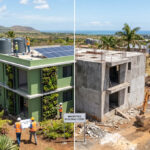
Increasingly, Mauritian developments are also incorporating on-site solar generation, taking advantage of the island’s strong solar resource to offset a meaningful portion of a building’s electricity demand, a strategy that carries particular appeal for a large-footprint development like The Cube, where substantial roof area provides genuine potential for meaningful on-site solar capacity relative to the building’s overall energy demand.
Water management in a water-stressed island context
Water management represents a further important dimension of sustainable construction in the Mauritian context, given the island’s exposure to both drought periods and intense seasonal rainfall. Sustainable water management strategies include rainwater harvesting systems that capture and reuse water for non-potable applications like landscaping irrigation, water-efficient fixtures throughout the development that reduce overall consumption, and stormwater management systems designed to handle intense seasonal rainfall without overwhelming surrounding drainage infrastructure or contributing to localised flooding.
For a development the scale of The Cube, with its substantial impervious surface area from buildings and parking infrastructure, thoughtful stormwater management represents a particularly important sustainability consideration, both for the development’s own resilience and to avoid negatively affecting drainage conditions in the surrounding area.
Landscape design as a water management tool
Beyond engineered stormwater infrastructure, thoughtful landscape design itself functions as a genuine water management tool for a development the scale of The Cube, permeable surfaces and vegetated areas that allow natural water absorption rather than directing all rainfall immediately into engineered drainage systems, and strategically placed green infrastructure that can temporarily hold and gradually release stormwater during intense rainfall events, reducing peak flow demands on the site’s engineered drainage capacity. Integrating this kind of landscape-based water management alongside more conventional engineered stormwater infrastructure typically produces a more resilient overall system than relying on engineered infrastructure alone, while also delivering the additional aesthetic and cooling benefits that thoughtful landscaping provides.
Material selection balancing local availability and sustainability
Material selection for a Mauritian development inevitably involves balancing sustainability considerations against the practical reality of the island’s dependence on imported construction materials. Favoring locally sourced or regionally available materials where feasible reduces the carbon footprint associated with long-distance shipping, while material durability, selecting materials that perform well and require minimal replacement over the building’s lifespan in Mauritius’s tropical, sometimes corrosive coastal climate, represents a further important sustainability consideration, since a material’s full lifecycle environmental impact includes not just its initial production and transport, but the frequency with which it needs replacement over a building’s operational life.
Certification frameworks and third-party verification
Increasingly, sustainable construction practice in markets like Mauritius is validated through third-party certification frameworks, international green building certification systems adapted to local conditions, or Mauritius-specific sustainability standards as they continue to develop. Pursuing this kind of third-party certification, rather than relying purely on internal claims about sustainability performance, provides greater credibility and accountability, offering tenants, investors, and the broader public a more objective basis for evaluating a development’s genuine sustainability performance relative to purely self-reported claims.
Construction-phase sustainability practices
Sustainability considerations extend beyond the completed building’s ongoing operational performance to encompass the construction process itself, waste management practices that divert construction debris from landfill where feasible, dust and erosion control measures that limit environmental impact on surrounding areas during the construction period, and responsible sourcing practices that consider the environmental and labour practices of material suppliers, not just the final material specification itself. For a project the scale of The Cube, spanning several years of active construction, these construction-phase practices represent a meaningful, if less publicly visible, component of the development’s overall environmental footprint.
Balancing sustainability investment against project economics
A recurring practical challenge in sustainable construction involves balancing the genuine upfront cost premium that many sustainability measures carry against a project’s overall financial feasibility, particularly for a large, complex development like The Cube where capital requirements are already substantial. The most defensible approach involves prioritising sustainability investments based on their full lifecycle economics, favouring measures that deliver genuine long-term operational savings sufficient to justify their upfront cost over a reasonable payback period, rather than pursuing sustainability measures indiscriminately regardless of their actual economic return, an approach that risks undermining the broader project’s viability and, ironically, its ability to be built at all.
Conclusion
Sustainable construction practice at a development like The Cube encompasses a genuinely comprehensive set of considerations, passive design suited to Mauritius’s tropical climate, energy-efficient building systems increasingly incorporating on-site renewable generation, thoughtful water management addressing both drought and intense rainfall risk, material selection balancing local availability against durability and lifecycle impact, third-party certification providing credible verification of genuine sustainability performance, and disciplined economic prioritization of sustainability investments. Applied consistently across a project of The Cube’s scale, these practices represent a meaningful contribution to Mauritius’s broader transition toward more environmentally responsible construction practice across its growing real estate sector.
As sustainability standards and expectations continue to rise globally and within Mauritius specifically, developments that have proactively invested in these practices from the outset will likely find themselves considerably better positioned than those that treat sustainability as an afterthought, both in terms of the direct operational cost savings these measures generate, and in terms of the increasingly important role sustainability credentials play in attracting quality tenants, investors, and buyers who factor environmental performance into their own decision-making.
 Previous Post
 Next Post